


|

|

|

|

|
By Lee Jun-tae, Reporter
June 10, 2026
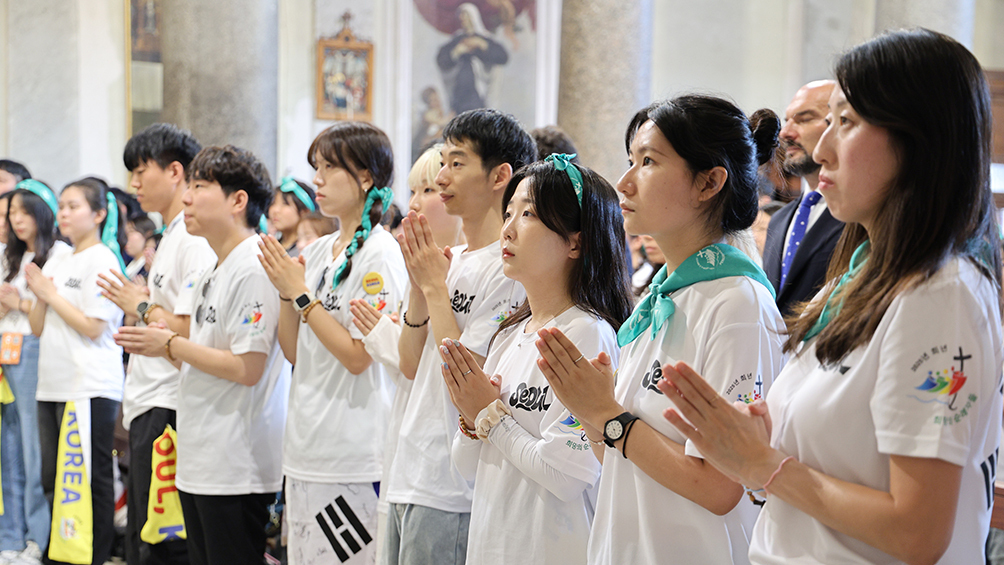
SEOUL — When hundreds of thousands of young Catholics from around the world gather in Seoul for World Youth Day (WYD) in August 2027, the challenge will extend far beyond liturgies and pilgrimages. The event will test South Korea’s capacity to manage one of the largest international gatherings in its history—and, in doing so, raise questions about the proper relationship between religion and the state.
A new legal study argues that government support for the event is not merely permissible but constitutionally justified.
Commissioned by the Seoul WYD Organising Committee and prepared by Bae, Kim & Lee LLC, the report, A Study on the Legal Justification for Government Support of the 2027 Seoul World Youth Day, was published in March. The study concludes that public assistance for WYD falls squarely within the government’s legal responsibilities.
Father Lee Young-je, head of the organising committee’s planning division, said the report was intended to demonstrate “how religion can contribute to society, and how the state, through religion, can also contribute.”
A Global Gathering With Public Consequences
The report begins by reframing World Youth Day not simply as a religious event but as a recurring international mega-event comparable in scale to the Olympics or the FIFA World Cup.
From the perspective of a host nation, the study argues, WYD functions as a major tourism driver, an instrument of cultural diplomacy and a vehicle for national branding. Such public benefits, the report says, provide a clear basis for government involvement.
The Archdiocese of Seoul expects between 400,000 and 800,000 participants at the closing Mass, while total attendance throughout the week could approach one million. More than 80 are expected to arrive from overseas.
Organisers estimate overall operating costs at between 295 billion won and 421.4 billion won (approximately US$215 million to US$307 million). More than half of the budget is expected to be spent directly on accommodation, transportation and meals for pilgrims.
The report also notes the symbolic significance of Seoul as host city. WYD 2027 will be the first World Youth Day held in a country where Christians do not constitute a majority of the population. The Korean Peninsula’s continuing division, the study argues, gives the event’s themes of peace and reconciliation particular international resonance.
Lessons From Saemangeum
Hovering over preparations is the memory of the 2023 World Scout Jamboree at Saemangeum.
The event became synonymous with organisational shortcomings after participants faced extreme heat, inadequate sanitation and a chaotic evacuation. The report warns that a gathering on the scale of WYD would face similar risks without strong government coordination.
World Youth Day is scheduled for August 3–8, the height of South Korea’s summer. Heatstroke, dehydration and other heat-related illnesses pose obvious dangers. Emergency medical services and the provision of drinking water therefore fall into areas where public authorities possess both expertise and responsibility.
The report also highlights the need for food-safety oversight, crowd management, disaster preparedness and coordinated responses to potential terrorism or criminal activity. Such tasks, the study argues, cannot be handled by religious organisers alone.
For that reason, the report calls for a government-led coordinating structure responsible for public administration, safety and emergency planning.
The Legal Basis for Support
The study estimates central-government support at approximately 49.2 billion won.
According to Oh Jeong-min, a lawyer at Bae, Kim & Lee, the figure compares favourably with public spending on other major international events.
“If we take the minimum attendance estimate of 700,000 participants, government support amounts to roughly 70,000 won per person,” he said. “That is significantly lower than comparable figures for other publicly supported events.”
The legal landscape has also changed.
On March 31 the National Assembly passed the Act on Support for International Cultural Events, introduced by Representative Im O-gyeong. The legislation extends to large cultural gatherings a framework of government assistance previously reserved largely for international sporting competitions and diplomatic conferences.
The law provides a statutory basis for support measures such as venue provision, security coordination and immigration facilitation.
Mr Oh described the legislation as recognition of an existing public duty rather than the creation of a new exception.
“Supporting international cultural events is a national responsibility that should be institutionally embedded,” he said.
The report further grounds government involvement in Article 9 of South Korea’s Constitution, which commits the state to advancing national culture. Additional authority derives from the Framework Act on Culture and the Framework Act on Tourism, both of which encourage cultural participation and the attraction of international visitors.
Church and State Beyond Rivalry
An appendix to the report addresses a more fundamental question: how does the Catholic Church understand the separation of church and state?
Drawing on research by Father Song Jeong-ho, a judge of the Tribunal of the Archdiocese of Seoul, the appendix argues that the Second Vatican Council transformed Catholic thinking on relations between religious and civil authority.
Rather than viewing church and state as rivals competing for influence, the council emphasized institutional autonomy combined with cooperation in pursuit of the common good. Such cooperation, Father Song argues, rests upon respect for human dignity and religious freedom.
The Catechism of the Catholic Church does not portray separation of church and state as hostility or indifference. Rather, the principle establishes an ordered relationship that protects religious liberty while limiting the power of public authorities.
Canon law reflects a similar approach. Catholics are generally expected to observe civil laws governing property, employment and related matters, provided such laws do not conflict with divine law. At the same time, clergy are prohibited from exercising political office, reinforcing the distinction between ecclesiastical and governmental authority.
From these principles, Father Song derives three arguments supporting public assistance for Catholic events.
The first concerns civic equality: Catholic taxpayers are entitled to receive public services on the same basis as other citizens.
The second concerns the common good: a gathering of this scale generates social, cultural and economic benefits extending well beyond the Catholic community.
The third concerns religious pluralism. Denying support to one religious group solely because of objections from another, Father Song argues, undermines the mutual respect upon which a pluralistic society depends.
The state’s role, he concludes, is not to privilege religion nor to exclude religion from public life, but to maintain a shared civic space in which different faiths can coexist and contribute to social cohesion.
For organisers of World Youth Day Seoul 2027, that principle may prove as important as any logistical plan. After the lessons of Saemangeum, the success of the gathering will depend not only on pilgrims and church leaders, but also on whether public institutions are prepared to treat the event as what the report says it has become: a matter of national interest as well as religious significance.
이준태 기자 ouioui@cpbc.co.kr


